
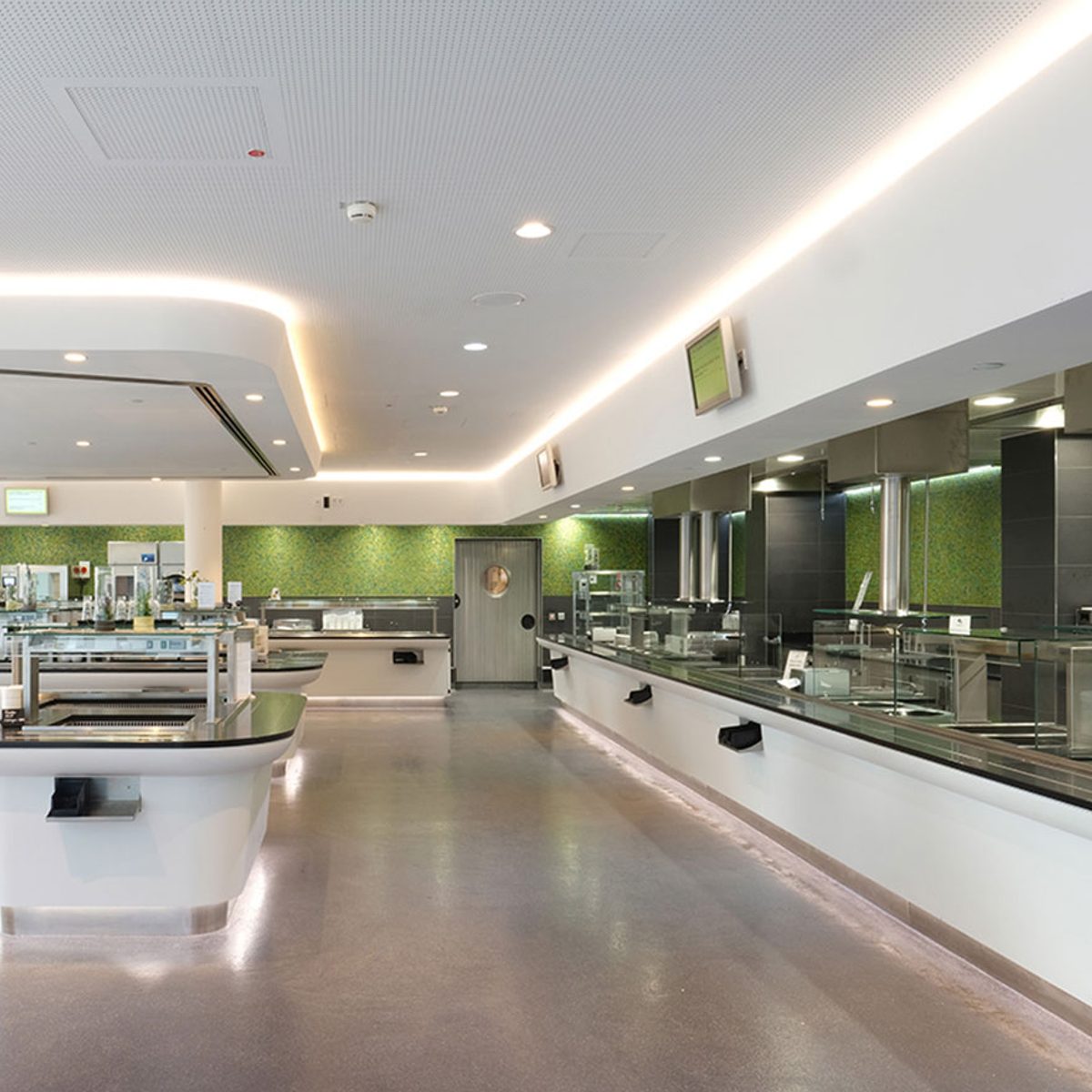
A canteen is not a scaled-up restaurant
A regular restaurant serves across the whole day; a staff canteen is short window, high volume. Within the single hour over lunch it may serve several hundred to over a thousand meals. That makes the equipment logic entirely different: batch cooking capacity, the link between holding and the serving line, and the instant peak at dishwashing all have to be designed for the peak, not the average.
Corporate and science-park sites also carry thresholds an ordinary restaurant does not: installation has to follow the site safety rules, layouts must pass internal audit, and noise and exhaust cannot affect the office and production areas. Whether a supplier has corporate-site experience shows directly in how smoothly the project goes in.
Three common build scenarios
| Scenario | Equipment focus | Common challenge |
|---|---|---|
| Corporate HQ / office tower | Floor-level integration of the serving line and flow; a light-meal and coffee-bar mix | Strict exhaust and noise limits; install windows mostly nights and weekends |
| Science park / plant | High-volume cooking (combi ovens, large cooking lines), conveyor dishwashing, tray-return flow | Headcount swings with shifts; high safety and audit requirements |
| Outsourced caterer on site | Configured to the caterer operating model, splitting central kitchen and on-site reheating | Specs must satisfy both the owner and the caterer |
Planning works back from serving volume
- Fix the serving model: self-run or outsourced, on-site cooking or central-kitchen delivery and reheating. This decides half of the equipment list.
- Size the peak: headcount, time window and menu type (buffet line, set meals, noodle stations) work back to cooking and serving-line capacity.
- Audit the infrastructure: power capacity, gas, water and drainage, and exhaust routes. In an office tower these are often the biggest constraint.
- Flow and hygiene: a one-way flow through goods-in, cooking, serving, return and washing that meets food-safety rules and internal audit.
- Phased handover and training: aligned to the company acceptance process, with operation and care handed over to the on-site team.
FAQ
How does canteen equipment differ from a regular restaurant?
The core difference is volume and time window: a canteen needs high-volume cooking equipment (combi ovens, large cooking lines), hot-holding serving equipment and a high-throughput wash line, sized to the peak rather than the average.
Should the company self-run or outsource to a caterer?
The two models plan differently: self-run needs a full cooking and washing set-up; outsourcing sets the depth of on-site equipment by the caterer operating model. Fix the operating model before planning the equipment.
Can an older building add a staff canteen?
Yes, but assess the infrastructure first: power capacity, exhaust routes and drainage are the three most common constraints, and the result sets the feasible range of menu type and equipment list.
How long does building a canteen take?
It varies widely by scale and site conditions, and corporate sites are often limited to night and weekend install windows. Plan a phased schedule, with a specific timeline provided after a site survey.
Assessing a staff canteen?
Tell us your headcount and site conditions: book a corporate-site assessment.
See also: product categories, the chain equipment strategy, hotel kitchen equipment planning.
Applied Kitchens plans and integrates equipment for corporate and science-park staff canteens and institutional catering kitchens, covering site survey, workflow drawings, equipment supply and after-sales maintenance, with a track record on corporate sites.