
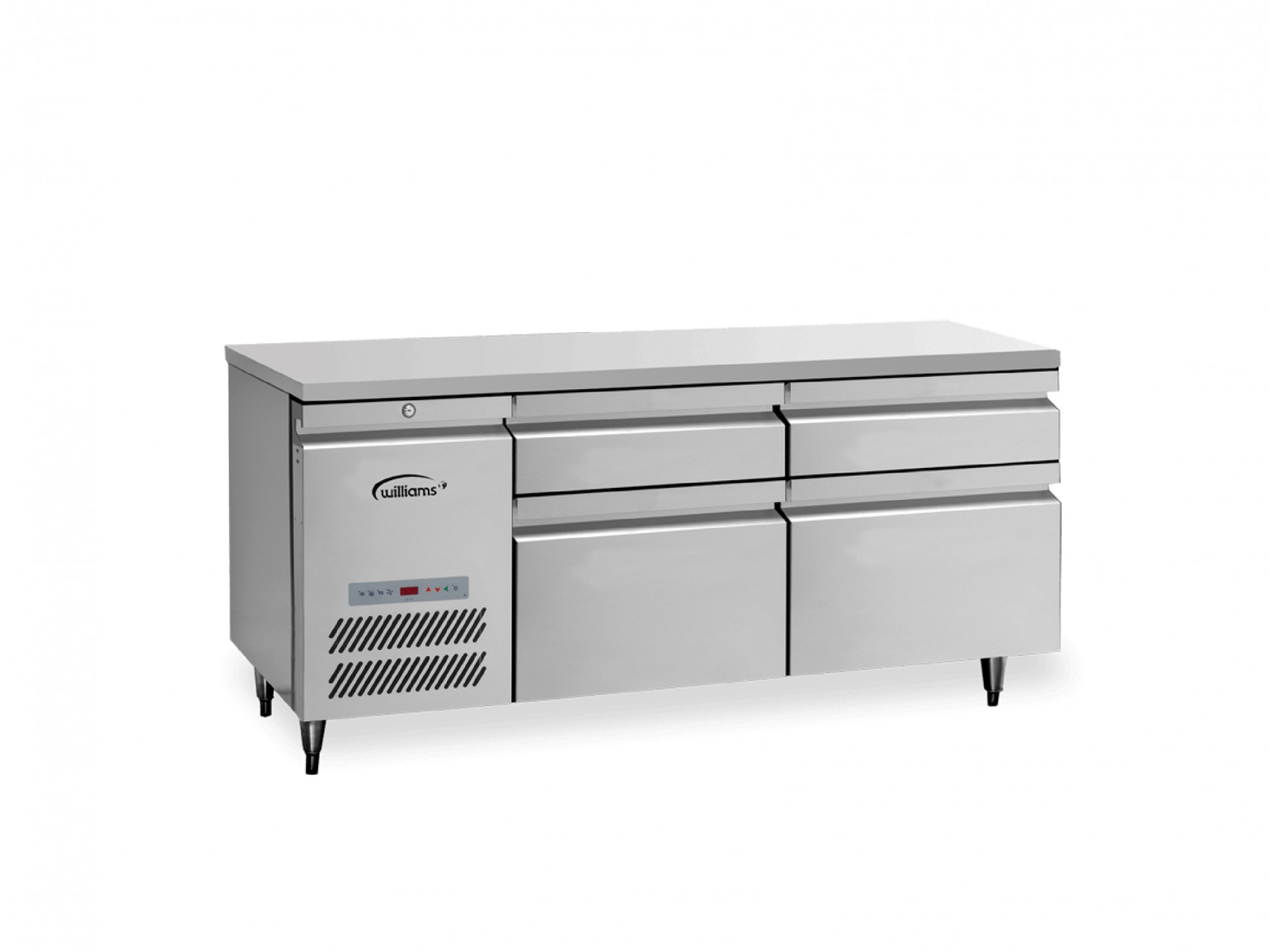
A refrigerated prep counter puts refrigerated storage under the worktop and a prep surface on top. Chefs can reach ingredients without turning to a fridge, which makes it a core piece of equipment on hot lines, cold stations and bars. These five points have the biggest impact on how well it works day to day.
1. Prep counter or upright fridge: how they share the work
The prep counter holds the ingredients needed within reach during service; the upright fridge holds backup stock in bulk. The two usually work together rather than replacing each other.
| Model | Type | Capacity | W×D×H (mm) | Power |
|---|---|---|---|---|
| Williams Emerald E2U-J | Refrigerated prep counter (two doors, 2/1 GN) | 547 L | 1765×770×850 | 220V single-phase |
| Williams Garnet G2T-J | Upright refrigerator | 1,301 L | 1400×824×1975 | 220V single-phase |
Specifications are taken from each product page; final configuration is confirmed in the quotation.
2. Doors or drawers?
Door models offer more complete storage for large containers and whole boxes of ingredients; drawer models show everything at a glance and are faster to reach, which suits fast-paced hot lines and bars. Williams prep counters can be specified with either, and GN pan wells can be added so frequently used toppings sit right on the worktop.
3. Number of doors and size: map the workflow first
Williams prep counters are available in two-, three- and four-door sizes. The Emerald E2U-J, for example, is 1765 mm wide, 770 mm deep and 850 mm high, with 547 litres of storage for 2/1 GN containers. Match the length to your kitchen layout and number of cooks, and allow space for opening doors or drawers so they do not block the walkway.
4. Worktop height and temperature zones
The worktop is your prep surface, so its height should line up with the surrounding counters and cooking line. Williams worktops are designed to align with island counters, and the top is thickened to 1.5 mm. Depending on the food you store, the Williams range also offers freezer, fish and meat temperature zones.
5. Energy use, temperature control and cleaning
A prep counter runs around the clock, so energy use and temperature stability show up in both operating costs and food quality. Williams units use the CoolSmart control system, with a digital display for real-time temperature monitoring and an automatic energy-saving mode during quiet periods. The E2U-J stands on 150 mm legs for easier floor cleaning and better airflow underneath.
Frequently Asked Questions
What is the difference between a prep counter and a refrigerator?
A prep counter puts refrigerated storage under the worktop so ingredients are within reach; an upright refrigerator has greater capacity for backup stock. Most kitchens use both.
Should I choose doors or drawers?
Choose doors for large containers and whole boxes, drawers for quick access and fast service. Williams offers both.
How long should a prep counter be?
It depends on your kitchen layout and number of cooks; allow space for opening doors or drawers. Williams offers two-, three- and four-door sizes.
Can a prep counter store frozen food?
You need a freezer model. The Williams range covers refrigerated, frozen, fish and meat temperature zones; confirm the right zone for your food when ordering.
What power does a prep counter need?
The Williams Emerald E2U-J, for example, runs on 220V single-phase. Check sockets and circuits before installation.
Next step
Book a site survey and specification review: Applied Kitchens will recommend prep counter and refrigerator configurations based on your menu, number of cooks and kitchen layout.
Further reading: Commercial refrigeration, Who should plan your restaurant kitchen?, Hotel kitchen equipment planning
Applied Kitchens is the Taiwan distributor for Rnice, Sunice and Varimixer and supplies international brands including Hobart, MEIKO, Kolb, Robot Coupe and Williams, providing equipment planning, supply, installation and after-sales service for commercial kitchens.