
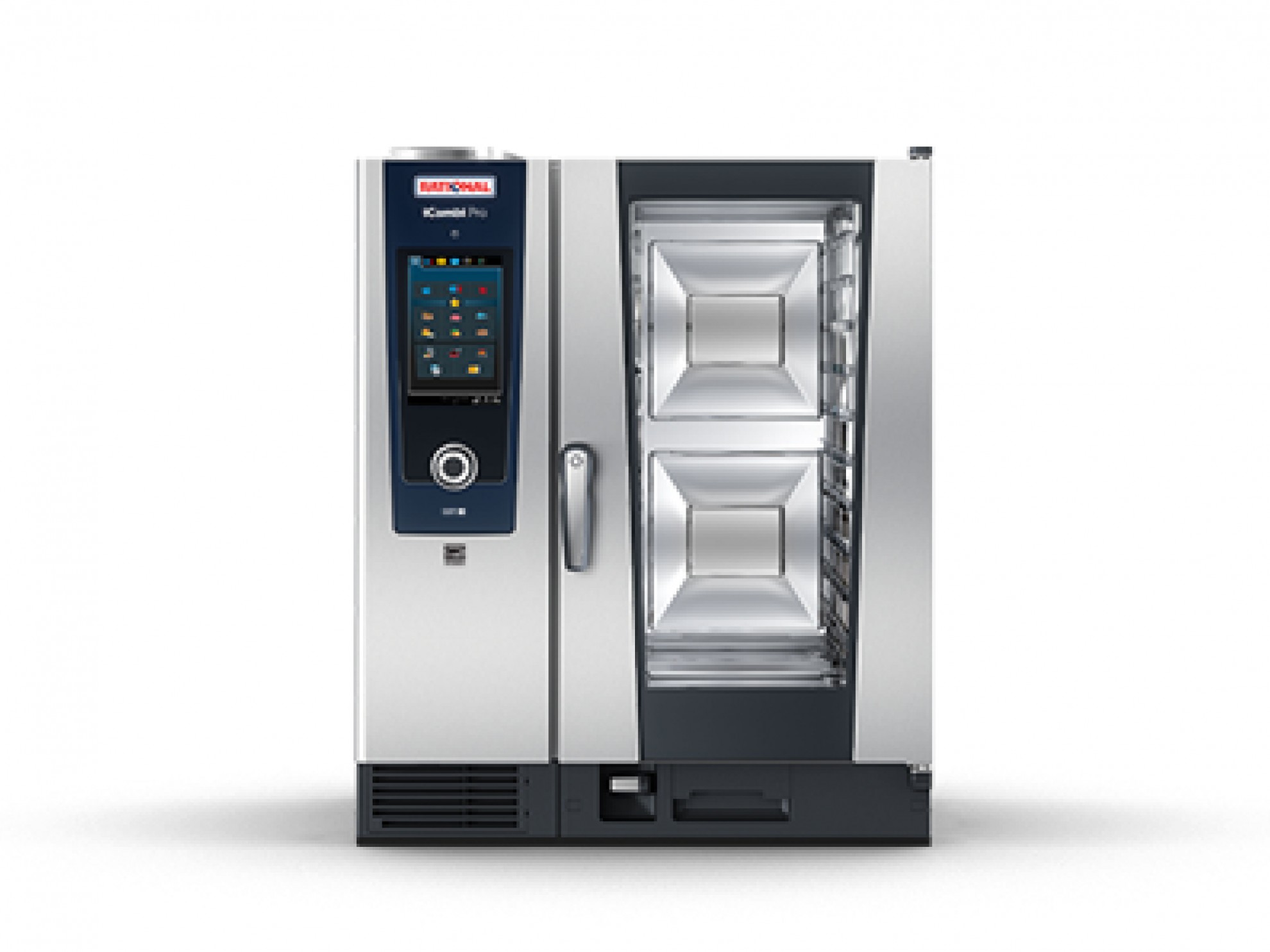
A combi oven combines convection, steam and combination cooking, so one unit can steam, roast, bake and cook at low temperature. That makes it the core appliance in hotel, contract catering and chain restaurant kitchens. It is also the equipment most often found to be wrong after purchase: too few trays and service stalls at the peak; not enough power and electrical work is added just before installation; no water connection planned and installation slips. Confirm these five points before you request a quote.
1. Size the tray capacity from your peak service
Tray capacity decides how much you can cook in one load. Do not size from an average day; work back from your busiest service and your highest-volume dish. The table below lists the models currently supplied by Applied Kitchens:
| Model | Capacity | Power | W×D×H (cm) | Best for |
|---|---|---|---|---|
| MKN Junior | Compact | 230V single-phase / 3.5kW | 55×63×75.8 | Cafés, light meals, kitchens short on space |
| Rational iCombi Pro XS | 6 × 2/3 GN | 220V single-phase / 5.7kW | 65.5×62.1×56.7 | Small restaurants, back-of-bar |
| Rational iCombi Pro 6-1/1 | 6 × 1/1 GN | 220V/380V, single- or three-phase / 10.8kW | 85×84.2×75.4 | Restaurants with steady volume |
| Rational iCombi Pro 10-1/1 | 10 × 1/1 GN | Three-phase / 18.9kW | 85×84.2×101.4 | Hotels, contract catering, staff canteens |
| Rational iCombi Pro 20-1/1 | 20 × 1/1 GN | Three-phase / 37.2kW | 87.7×91.3×180.7 | Contract catering, central kitchens, hotel banquets |
| Angelo Po ACT.O | 6 / 10 / 20 × 1/1 GN | Per specification | Per specification | Kitchens that need low-temperature cooking and remote monitoring |
Specifications are taken from each product page; final configuration is confirmed in the quotation.
2. Check the power supply: single-phase or three-phase
Compact models such as the iCombi Pro XS and MKN Junior run on single-phase power, which is easier for shopfronts, although a dedicated circuit may still be needed. Models with 10 trays or more need three-phase power, starting at 18.9kW. Malls and older buildings often lack electrical capacity, so confirm the existing supply during the site survey rather than discovering extra electrical work when the oven arrives.
3. Plan water and drainage, and treat the water
A combi oven needs both a water supply and a drain. For the Rational iCombi Pro, the water inlet is R 3/4 inch, the drain DN 40 to DN 50, and water pressure must be between 1.0 and 6.0 bar. Mineral-rich water causes scale that affects steam performance and equipment life, so plan commercial water filtration at the same time.
4. Measure the space and check ventilation
Beyond the cabinet size, allow room for the door to open and for servicing. The 20-tray model is over 180 cm tall, so measure the delivery route and door widths first. Where there is no exhaust duct, the MKN Junior can be fitted with the MagicHood option to filter grease and odours; whether extraction is required still depends on the building's rules.
5. Judge the controls and cleaning, not just the feature list
In kitchens with high staff turnover, an easy interface matters more than the number of functions. The Rational iCombi Pro offers intelligent controls and multiple automatic cleaning modes; the MKN Junior uses MagicPilot touch control with Guided Cooking; the Angelo Po ACT.O has a 10-inch full-colour touchscreen with real-time monitoring from a mobile device. Applied Kitchens provides operator training at handover, followed by servicing and maintenance.
How to compare combi oven prices
Combi oven prices depend mainly on tray capacity, brand and features, plus electrical and plumbing work, water treatment and ongoing maintenance. When comparing quotes, look at total cost of ownership rather than purchase price alone; see the real cost of kitchen equipment. Applied Kitchens quotes by specification.
Frequently Asked Questions
How is a combi oven different from a conventional oven?
A conventional oven uses dry heat only. A combi oven controls both temperature and humidity, so it can steam, roast, bake and combine methods, replacing several appliances with one.
Should I choose 6 or 10 trays?
Work back from the largest volume in your peak service. Restaurants with steady volume usually choose 6 trays; hotels, contract caterers and staff canteens usually choose 10 or more.
Does a combi oven need three-phase power?
Not always. The Rational iCombi Pro XS and MKN Junior run on single-phase power; models with 10 trays or more need three-phase.
Does a combi oven need a water connection?
Yes. The steam function needs a water supply and a drain. In areas with hard water, water filtration is recommended.
Does a small restaurant need a combi oven? What compact options are there?
If your menu uses both steaming and roasting, or you want fewer appliances, consider a compact single-phase model such as the MKN Junior or Rational iCombi Pro XS.
Next step
Book a site survey and specification review: Applied Kitchens will check power, water and space, then recommend a model based on your menu and service volume.
Further reading: Commercial cooking equipment, Hotel kitchen equipment planning, Staff canteen and contract catering kitchen planning