
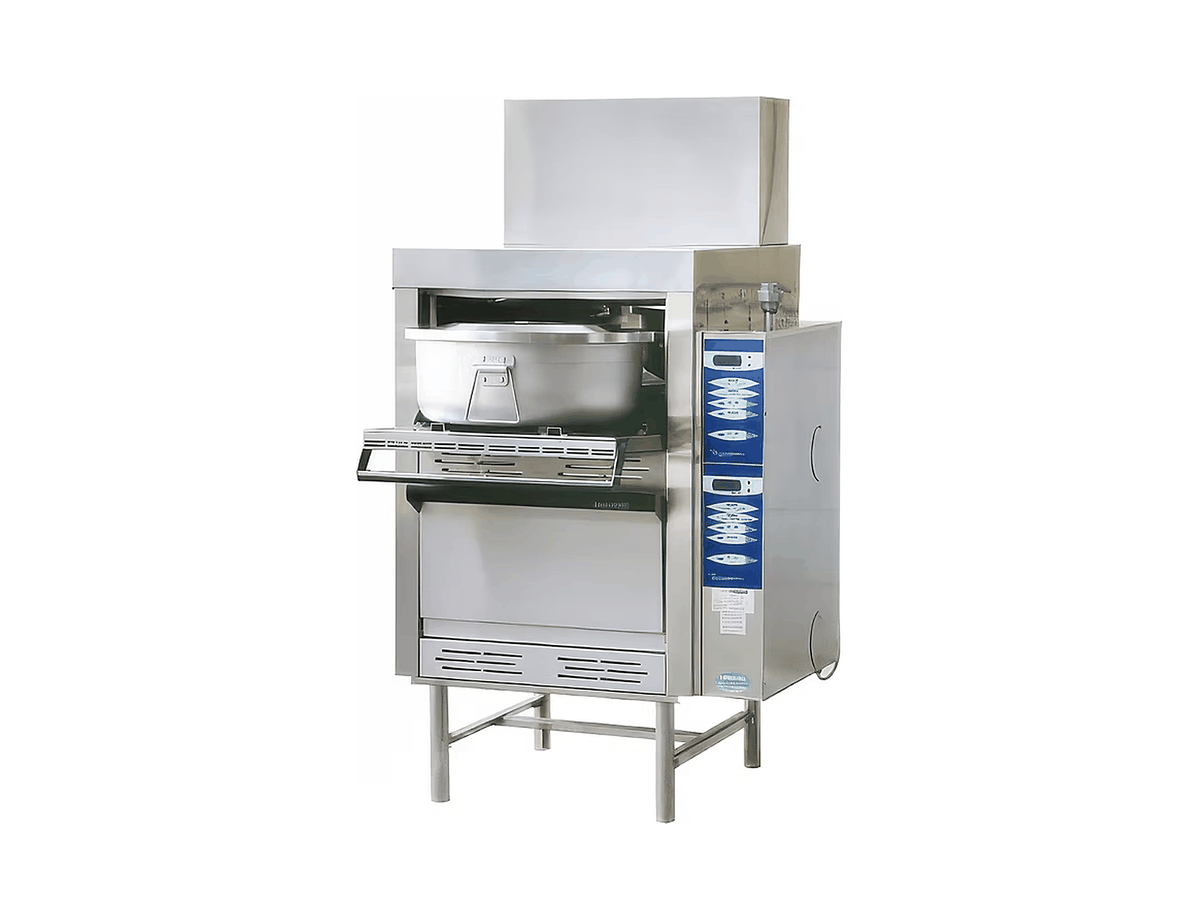
A commercial rice cooker determines how much rice a kitchen can serve reliably each day. Contract catering, staff canteens and lunch box operations usually choose upright multi-tier units that cook large batches at once. Restaurants with moderate volumes and limited space can work with a single-pot countertop model. Look at four things: capacity and tiers, unit height, gas supply and operation.
1. Capacity and tiers: size to your largest meal
Each tier of an upright multi-tier rice cooker holds one pot, so more tiers means more rice per batch. These are the HATTORI models supplied by Applied Kitchens:
| Model | Type | Rice capacity | Gas consumption | W × D × H (mm) |
|---|---|---|---|---|
| HATTORI LG-000-100 / 150 | Upright, 2 / 3 tiers | 14 / 21 kg | 20.9 / 31.4 kW | 760×774×1490 / 1688 |
| HATTORI LGS-100 / 150 | Upright, 2 / 3 tiers | 14 / 21 kg | 20.9 / 31.4 kW | 731×725×1127 / 1325 |
| Hattori GRC-10L | Single-pot countertop | 8.5 kg | 8.0 kW | 595×485×455 |
Specifications are taken from each product page. Final configuration is confirmed in the quotation.
2. Unit height and kitchen environment
At the same 2 or 3 tiers, the LGS series is slightly smaller and noticeably shorter than the LG-000, which helps where ceiling height is limited. The LG-000 is the top-of-range model. It exhausts heat from the top of the unit, so the area around the machine stays cooler, a real benefit in kitchens running long, continuous service.
3. Confirm the gas supply first
These rice cookers are gas-fired. Before installation, confirm the gas supply, ventilation and local regulations on site, and have the work done by qualified professionals. The Hattori GRC-10L, for example, runs on LPG with 8.0 kW gas consumption, a 9.5 mm pipe and 2.8 kPa supply pressure. The upright multi-tier models also need a 220V single-phase power supply.
4. Operation and scheduling
Kitchens with fixed service times benefit most from a model with delayed start. The HATTORI LG-000 and LGS series both have countdown and delayed-start functions, so the start time can be set back from service time and soaking and cooking run as one sequence. The LGS series also offers both a dual temperature sensor mode and a timer mode. The Hattori GRC-10L starts with an ignition lever, making it simple for new staff to learn.
FAQ
How many tiers does a commercial rice cooker need?
Work back from the largest single-meal volume. The HATTORI upright models cook 14 kg with 2 tiers and 21 kg with 3 tiers. For moderate volumes, the single-pot GRC-10L at 8.5 kg is enough.
What is the difference between the LG-000 and LGS?
Both have the same rice capacity. The LG-000 is the top-of-range model and exhausts heat from the top, so its surroundings stay cooler. The LGS is smaller and shorter, offers a dual temperature sensor mode and a timer mode, and is easier to fit where ceiling height is limited.
Can a commercial rice cooker be set to start later?
Yes. The HATTORI LG-000 and LGS series both have countdown and delayed-start functions, so the start time can be set from your service time.
Does a commercial rice cooker need a gas connection?
All HATTORI models in this guide are gas-fired. Qualified professionals must confirm the gas supply, ventilation and local regulations before installation.
How many rice cookers does a staff canteen need?
Work back from headcount, menu and service window, and consider hot holding and distribution at the same time. For overall planning, see Staff Canteen and Contract Catering Kitchen Planning.
Next step
Book a site survey and specification review: Applied Kitchens will check gas, power and ceiling height first, then recommend models and quantities based on your headcount.
Related reading: Commercial Cooking Equipment, Staff Canteen and Contract Catering Kitchen Planning, Combi Oven Buying Guide
Applied Kitchens supplies HATTORI rice cookers and equipment from other international brands, with commercial kitchen planning, supply, installation and after-sales service.